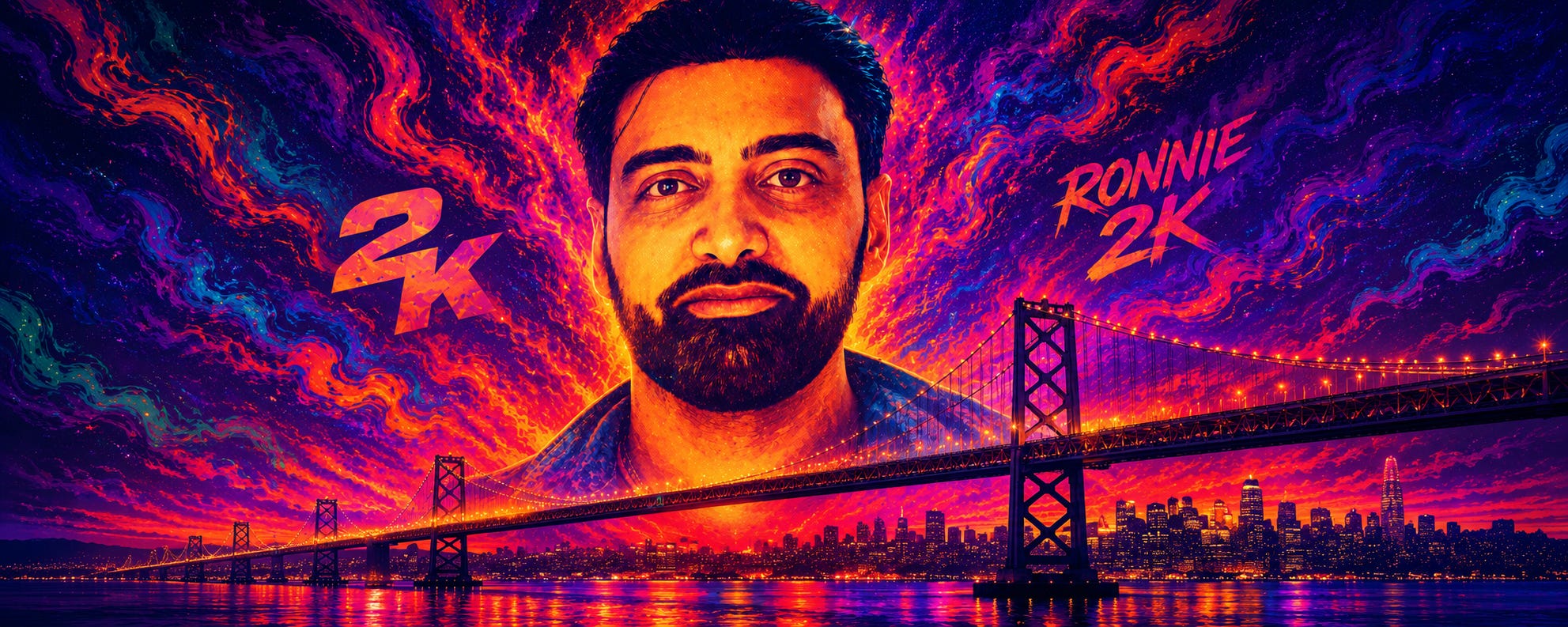
Ronnie 2K Brings NBA 2K home to the Bay Area with Boys and Girls Club San Francisco
After helping launch courts around the world, Ronnie Singh finally saw NBA 2K Foundations build one in his own backyard at the Excelsior Boys & Girls Club.
For nearly two decades, if you’ve played NBA 2K, you’ve heard the name Ronnie 2K.
He’s been the face of the franchise through console generations, cover athlete reveals, viral moments, player ratings debates, and the rise of NBA 2K from basketball video game to full-blown global culture machine. From your TV screen to your game console to social media timelines across the world, Ronnie Singh has spent years helping shape how an entire generation experiences basketball culture.
Now, after 57 court renovations across the globe through 2K Foundations, the mission finally came home as 2K partnered with the Boys & Girls Club of San Francisco to unveil a newly refurbished basketball court at the Excelsior Clubhouse, giving hundreds of local kids a brand-new space to hoop right in the heart of the city. And for Ronnie, a Bay Area native who’s lived here nearly 40 years, this one hit in a whole new way.
Because after helping bring courts to communities around the world, he finally got to see one built in San Francisco. I caught up with Ronnie during the event to talk about basketball culture, community impact, Steph Curry’s influence on 2K itself, and why he still thinks something might be brewing for the Warriors heading into next season.
Daniel: Alright, we’re rolling here with Ronnie 2K. Thanks for joining me again, man.
Ronnie 2K: Of course. Always a pleasure.
Daniel: This is interview number three now.
Ronnie 2K: Three? Wow. We’re putting our time in.
Daniel: We’ve seen 2K Foundations build courts all over the world, but this is the first one right here in your own backyard in the Bay Area. What does that mean to you personally?
Ronnie 2K: It’s crazy. I figured in the 57 courts that we’ve done around the world that we would’ve come to our backyard already, but apparently we hadn’t. I’ve lived here almost 40 years in the Bay, so it means a lot to me.
To do this in the local community, especially with basketball meaning so much to us as an organization through NBA 2K, we want to give kids opportunities to learn teamwork, leadership, and build community. And maybe one day we’ll even hire one of these local kids. That’d be amazing. The Boys & Girls Club has also been such a great partner because they already do incredible things for kids in the community, and that’s exactly the kind of work we want to align ourselves with.
Daniel: 2K built one of the biggest indoor hobbies on earth. Now you guys are out here building real courts and encouraging kids to get outside and hoop, what a full-circle moment. What does that responsibility mean to you?
Ronnie 2K: We have a responsibility to help grow the next generation of hoopers, and that’s gonna come through community programs and safe places to play basketball. Otherwise, some of these kids could end up turning toward unsafe activities, and that’s why this matters.
And I get what you’re saying. Obviously our job is to get people to play the game, but everything adjacent to the game matters too. We do a lot with music, fashion, education. A couple weeks ago we did a really cool program in Baltimore with Angel Reese where we brought together around 60 young women for a STEM event based around the science of basketball.
They had sessions involving physics, reaction time, rebounding mechanics, even hair-braiding classes. It was all about connecting authentically with the local community and showing kids that basketball can open doors beyond just becoming an NBA player. We’re not expecting every kid who walks through these doors to make the league. But we do hope they become strong members of their communities and build platforms for good.
Daniel: Was there a court growing up in the Bay that felt like your court? The place where you really fell in love with basketball?
Ronnie 2K: I grew up in Marin, and there’s this beautiful court in Sausalito that overlooks the Bay and the Golden Gate Bridge. I used to go there all the time to get shots up.
I’ve shot a lot of content there over the years too. That was definitely my spot.
And then I stayed close to my middle school and high school courts because there was always really strong competition there. I didn’t venture too much into the East Bay or South Bay because I found some really beautiful courts up in the North Bay.
Daniel: Eighteen years with 2K now. At this point, you’ve watched this thing grow from a basketball game into a global culture brand. How much did your own experience growing up with basketball shape the way you approach the job?
Ronnie 2K: A lot. The reason we do these community programs is to educate and inspire the next generation, not just to become better basketball players, but better leaders in their communities. I knew pretty early on I wasn’t gonna be in the NBA. I was good, but I wasn’t top-450-in-the-world good.
But basketball still gave me so much. It taught confidence, teamwork, communication, leadership. Those things translate directly into life skills. A lot of what I do now, relating to NBA players and creating content, comes from confidence I gained on the basketball court and through playing 2K. All of it works hand in hand.
Daniel: Whenever somebody gets mad playing 2K, somehow your name ends up trending online.
Ronnie 2K: Oh, it usually is my fault somehow.
Daniel: When it’s all said and done and your jersey’s hanging in the rafters at 2K, what do you want your legacy to be?
Ronnie 2K: I hope my legacy is that I used this platform responsibly. I’ve had this incredible opportunity to connect with basketball fans of all ages. It’s amazing how deep 2K runs through generations. I’ve had conversations with six- and seven-year-olds about the game.
I hope people think I represented the brand well, but more importantly that I left things in a better place.
When I started 18 years ago, 2K wasn’t even the biggest basketball video game on the planet. Now it’s one of the biggest entertainment brands in the world. And being even a small part of helping grow it into something that can do programs like this, work with Make-A-Wish, build 57 courts globally, that means a lot. You can only become a platform for good if you become a platform first.
I just hope people feel like I did the right thing with that opportunity.
Daniel: Right on. Last time we talked was All-Star Weekend San Francisco. Jimmy Butler had just arrived, the energy was sky high, everybody was dreaming big. Fast forward a few months and now the conversation has shifted toward age, injuries, and whether this might be the final chapter of the dynasty. As a Bay Area guy, how are you processing this version of the Warriors?
Ronnie 2K: It’s interesting because I really don’t think Steve Kerr was posturing after that last game when they had the group hug and all that. I genuinely think he believed that might’ve been it. But something’s not adding up to me.
I feel like something is coming. Like there’s another move, another burst of energy on the horizon for this franchise. Steph wants to play until he’s 40. The guy just doesn’t slow down.
But rerunning the exact same roster doesn’t quite feel like the full plan to me. They’ve got some exciting young guys, one of them’s here today with Will Richard, but I really think Mike Dunleavy has something cooking.
I don’t know what it is yet, but something feels like it’s coming.
Daniel: Warriors fans have spent years begging for higher Steph Curry ratings in 2K, but what’s fascinating is that Steph didn’t just change basketball in real life. He changed basketball in 2K too. Suddenly everybody wanted to shoot from 35 feet and build their player around range. How much did Steph actually force 2K itself to evolve?
Ronnie 2K: With Steph, everything he’s done has been fantastic. I’m incredibly proud of him and everything he’s accomplished. But specifically for 2K, he forced us to change the game. Just like he forced the NBA itself to evolve from twos into threes. I remember our 2K16 campaign when Steph was one of our cover athletes. The entire campaign theme was “Break the Game.” And he really did.
When he was hitting over 400 threes in a season, that completely changed basketball forever. I honestly don’t think we’ll ever see anything like that again over the course of an entire career. Everybody suddenly thought 5,000 career threes would become normal. It’s not normal. What he’s done is remarkable.
But it also changed how we had to develop 2K itself. We had to make outside shooting feel more realistic and more accessible because everybody wanted to be Steph. People build their players around deep shooting now. The farther you can shoot, the more people love it. A lot of our badges and gameplay systems evolved because of that influence.
He’s one of the biggest legacy-shifting players in NBA history. Honestly, maybe the second most important player in NBA history. Not the second greatest player. The second most important. That’s how big his impact has been.
Daniel: I LOVE what Steph did to the league and to the video game. Even if, to quote Paul George: “That’s a bad shot.” I appreciate you, brother.
Ronnie 2K: Of course, man. Appreciate you too.
Daniel: Alright, let me grab my basketball before the kids rush the court.


